Materiality - Focus on What Matters
Identify and prioritize material ESG topics through structured stakeholder engagement.
What is Materiality?
Materiality helps you identify which ESG topics matter most to your organization and stakeholders. It's where you:
- Engage stakeholders - Gather diverse perspectives
- Assess topics - Evaluate significance and impact
- Prioritize issues - Focus on what's material
- Define policies - Create action plans
- Update regularly - Keep assessments current
The EXO.G Materiality Workflow
EXO.G guides you through a comprehensive 6-step process, from mapping stakeholders to finalizing material topics.
🗺️ Step 1: Map Stakeholders & Value Chain Entities
What you do: Identify and classify all entities you have relationships with.
- Add stakeholders and value chain entities
- Classify by category (Employees, Suppliers, Customers, Investors, Community, etc.)
- Define their sector (industry classification)
- Set position in chain: Upstream, Downstream, or Own Operations
Why it matters: This mapping is crucial - it defines who will participate in your assessment and receive engagement links in Step 4.
📊 Step 2: Pre-Assessment (Internal)
What you do: Your team internally evaluates which topics might be material and why.
- Review the topic library (GRI, ESRS standards)
- For each topic, assess if it's potentially material
- Document your reasoning and justification
- Establish your organization's baseline view
Why it matters: Creates your internal perspective before engaging stakeholders.
⚠️ Step 3: Create IROs (Impacts, Risks, Opportunities)
What you do: Identify specific impacts, risks, and opportunities.
- Create IROs for internal operations (your direct impacts)
- Create IROs for value chain (supplier and partner impacts)
- Create IROs for stakeholder concerns
- Link IROs to material topics, stakeholders, and value chain entities
Why it matters: Provides concrete context for stakeholder voting and creates the foundation for risk management.
🔗 Step 4: Stakeholder Engagement (The Magic Link)
What you do: Invite stakeholders and value chain entities to participate.
EXO.G automatically:
- Creates secure, personalized links for each stakeholder
- Knows which reporting standards you use
- Requests relevant ESG data from value chain entities
Stakeholders can:
- Vote on material topics
- Discuss via built-in communication tools
- Share data automatically (suppliers share emissions, labor data, etc.)
Why it matters: Transparent, secure, and easy engagement. Value chain entities share real ESG datapoints directly, eliminating manual data collection.
📋 Step 5: Policies, Action Plans & Targets
What you do: Define how you'll address material topics across your value chain.
For each material topic:
- Create policies (your commitments)
- Define action plans (specific initiatives)
- Set targets (measurable goals)
- Assign responsibilities (who owns what)
- Include value chain entities (collaborative targets with suppliers)
Why it matters: Qualifies the entire business value chain and establishes risk mitigation strategies involving all stakeholders.
✅ Step 6: Review & Finalize Material Topics
What you do: Review all inputs and select your final set of material topics.
Review:
- Internal pre-assessment
- Stakeholder votes and feedback
- IRO analysis
- Value chain input
- Discussion threads
Then:
- Adjust materiality scores based on all inputs
- Set materiality threshold
- Finalize your material topics list
- Document rationale for decisions
Why it matters: Creates your official material topics list based on comprehensive, transparent analysis - ready for reporting.
From IROs to Policies, Action Plans and Targets (PAT)
The IROs you create in Step 3 show where impacts, risks and opportunities sit in your own operations and across the value chain. This reveals:
- Gaps where there is no clear policy or action yet.
- Opportunities where a target would make expectations concrete.
Step 5 turns these IROs into Policies, Action Plans and Targets (PAT) that you can follow up and communicate clearly.
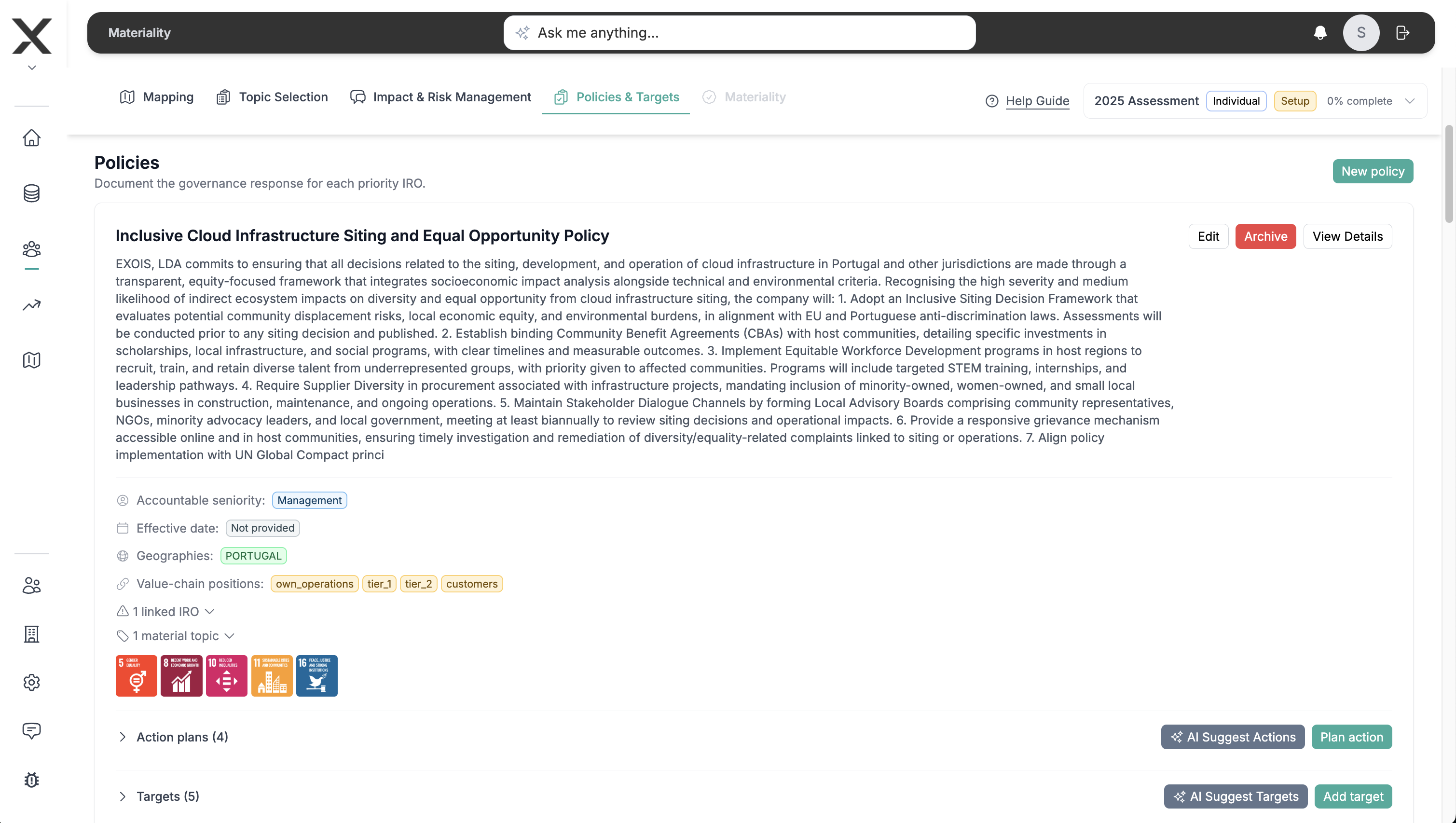
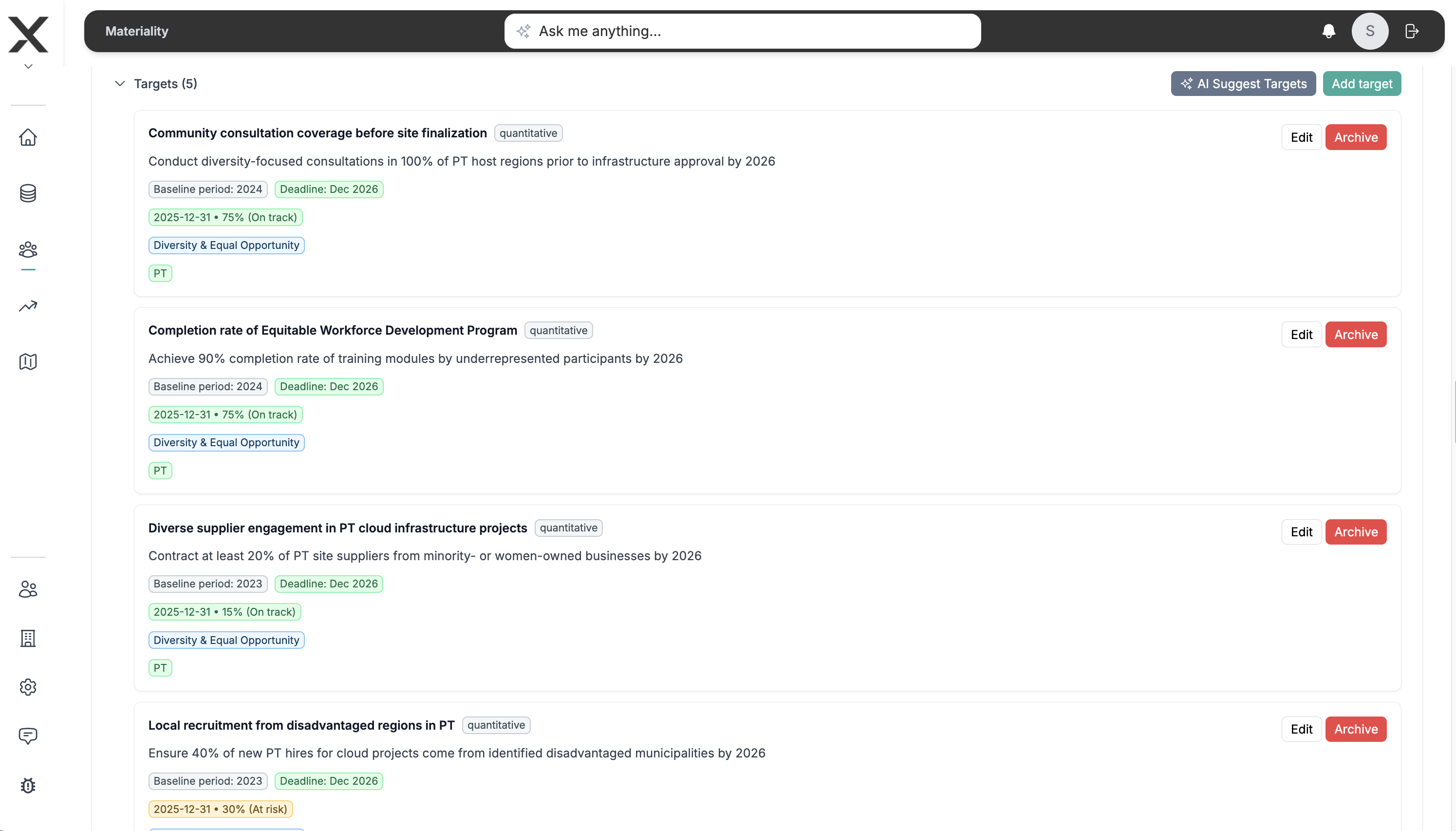
PAT PDF export
You can export the full PAT view to PDF:
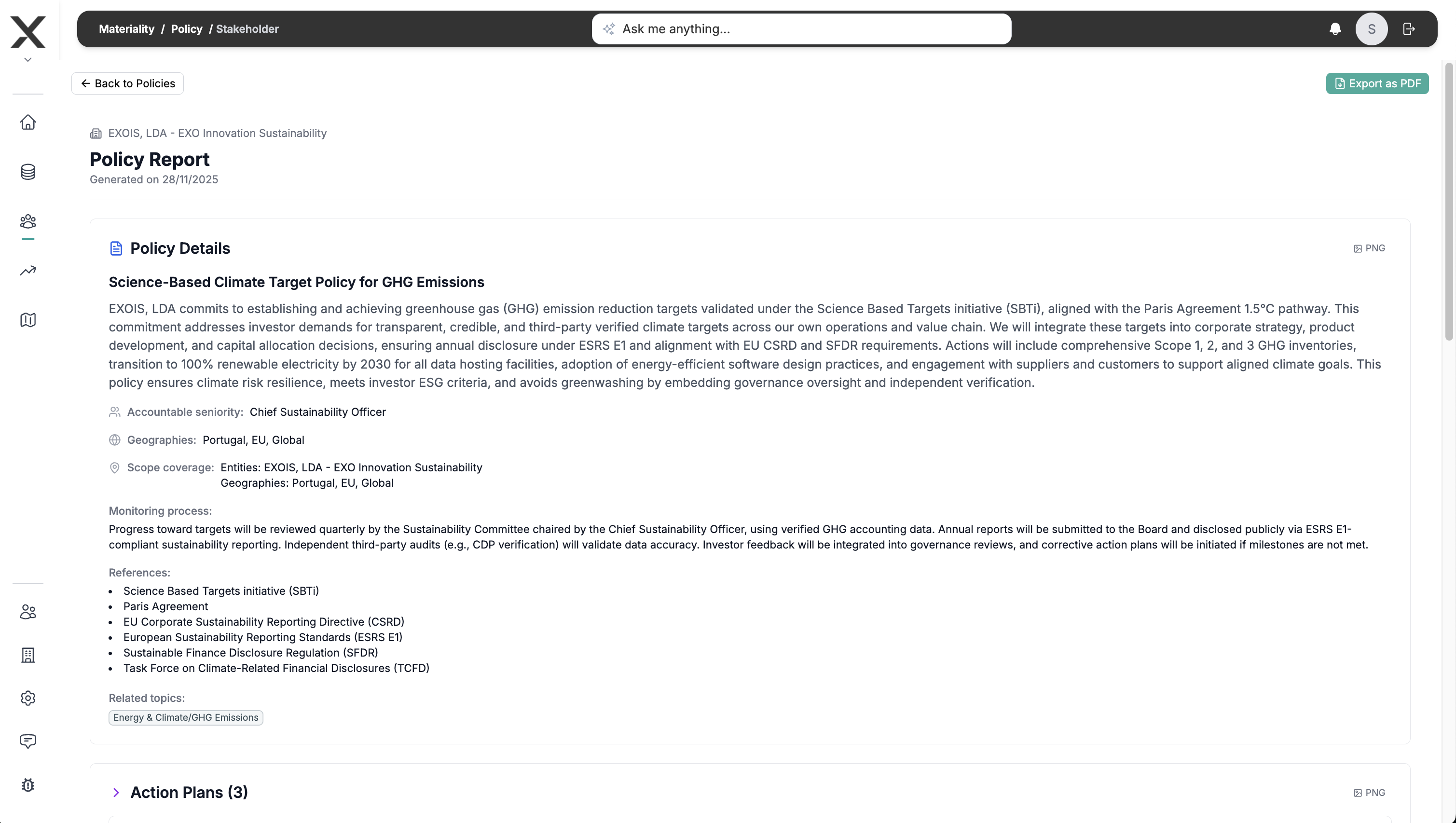
This is useful to:
- Show clear commitments to investors and stakeholders.
- Demonstrate risk management maturity over your topics and IROs.
- Have an official PAT document ready for audits and reviews.
What is a Material Topic?
A material topic is an ESG issue that:
- Has significant environmental or social impacts (impact materiality)
- Creates financial risks or opportunities (financial materiality)
- Matters to key stakeholders
- Influences business decisions
Key Capabilities
👤 Stakeholder Management
Identify and engage your stakeholders:
- Internal stakeholders - Employees, management, board
- External stakeholders - Customers, suppliers, investors, communities
- Stakeholder groups - Organize by type or interest
- Engagement tracking - Record interactions
- Survey distribution - Collect feedback systematically
📋 Materiality Assessment
Conduct structured assessments:
- Topic library - Pre-loaded ESG topics (GRI, ESRS)
- Custom topics - Add organization-specific issues
- Double materiality - Impact + Financial assessment
- Scoring system - Rate significance (1-5 scale)
- Stakeholder input - Weighted responses
- Automated analysis - Generate materiality matrix
🎯 Topic Prioritization
Focus resources on material topics:
- Materiality matrix - Visual prioritization
- Threshold setting - Define materiality cutoffs
- Topic ranking - Order by significance
- Category filtering - Environmental, Social, Governance
- Trend tracking - See how materiality changes over time
📜 Policy Management
Define responses to material topics:
- Policy creation - Document commitments
- Action plans - Define specific initiatives
- Responsibility assignment - Assign owners
- Progress tracking - Monitor implementation
- Policy updates - Revise based on results
🔄 Ongoing Management
Keep materiality current:
- Annual reviews - Reassess annually
- Continuous monitoring - Track topic relevance
- Stakeholder updates - Re-engage regularly
- Topic emergence - Add new issues as they arise
How to Use Materiality
Step 1: Identify Stakeholders
- Go to Materiality → Stakeholders
- Click "Add Stakeholder"
- Select stakeholder type:
- Employees
- Customers
- Suppliers
- Investors
- Community
- Regulators
- NGOs
- Add contact details
- Assign to stakeholder groups
Step 2: Create Assessment
- Go to Materiality → Assessments
- Click "New Assessment"
- Name your assessment (e.g., "2024 Materiality Assessment")
- Select topics from library or add custom
- Configure double materiality scales:
- Impact materiality: Environmental/social impact
- Financial materiality: Business risks/opportunities
- Set assessment period
- Click "Create"
Step 3: Engage Stakeholders
- Open your assessment
- Click "Invite Stakeholders"
- Select stakeholder groups
- Customize invitation message
- Set response deadline
- Click "Send Invitations"
- Stakeholders receive link to assessment survey
Step 4: Collect Responses
- Monitor response rates in real-time
- Send reminders to non-responders
- Review individual responses (anonymized)
- Add internal management scores
- Weight stakeholder groups (optional)
Step 5: Analyze Results
- View materiality matrix automatically generated
- Identify material topics (above threshold)
- Review topic rankings
- Compare with previous assessments
- Use the results as input for your reporting and decisions
Step 6: Define Policies
- For each material topic:
- Click "Create Policy"
- Document your commitment
- Define specific actions
- Assign responsibility
- Set timelines
- Link to Core actions
Integration with Other Features
← Core
Core data informs materiality assessment.
Example: High water usage in Core → Flags water as topic to assess in Materiality
← Performance
Performance metrics show topic significance.
Example: Rising emissions trend → Increases climate topic materiality score
→ Value Chain
Material topics guide value chain engagement.
Example: Labor practices identified as material → Engage suppliers on labor issues
→ Risk Management
Material topics become risk assessment inputs.
Example: Water stress material → Assess water-related risks in Risk Management
← Collaboration
Stakeholder management leverages collaboration features.
Example: Invite external stakeholders for materiality survey
Best Practices
Engage Broadly
- Include diverse stakeholder groups
- Balance internal and external voices
- Reach underrepresented groups
- Ensure senior management participation
Be Systematic
- Use structured methodology (GRI, ESRS)
- Document process clearly
- Keep consistent scales
- Maintain audit trail
Update Regularly
- Reassess annually minimum
- Monitor emerging topics
- Track stakeholder concerns
- Adjust policies as needed
Act on Results
- Focus on material topics
- Set clear policies
- Allocate resources appropriately
- Report on progress
Communicate Results
- Share findings with stakeholders
- Explain methodology
- Show how input influenced decisions
- Report in ESG disclosures
Double Materiality Explained
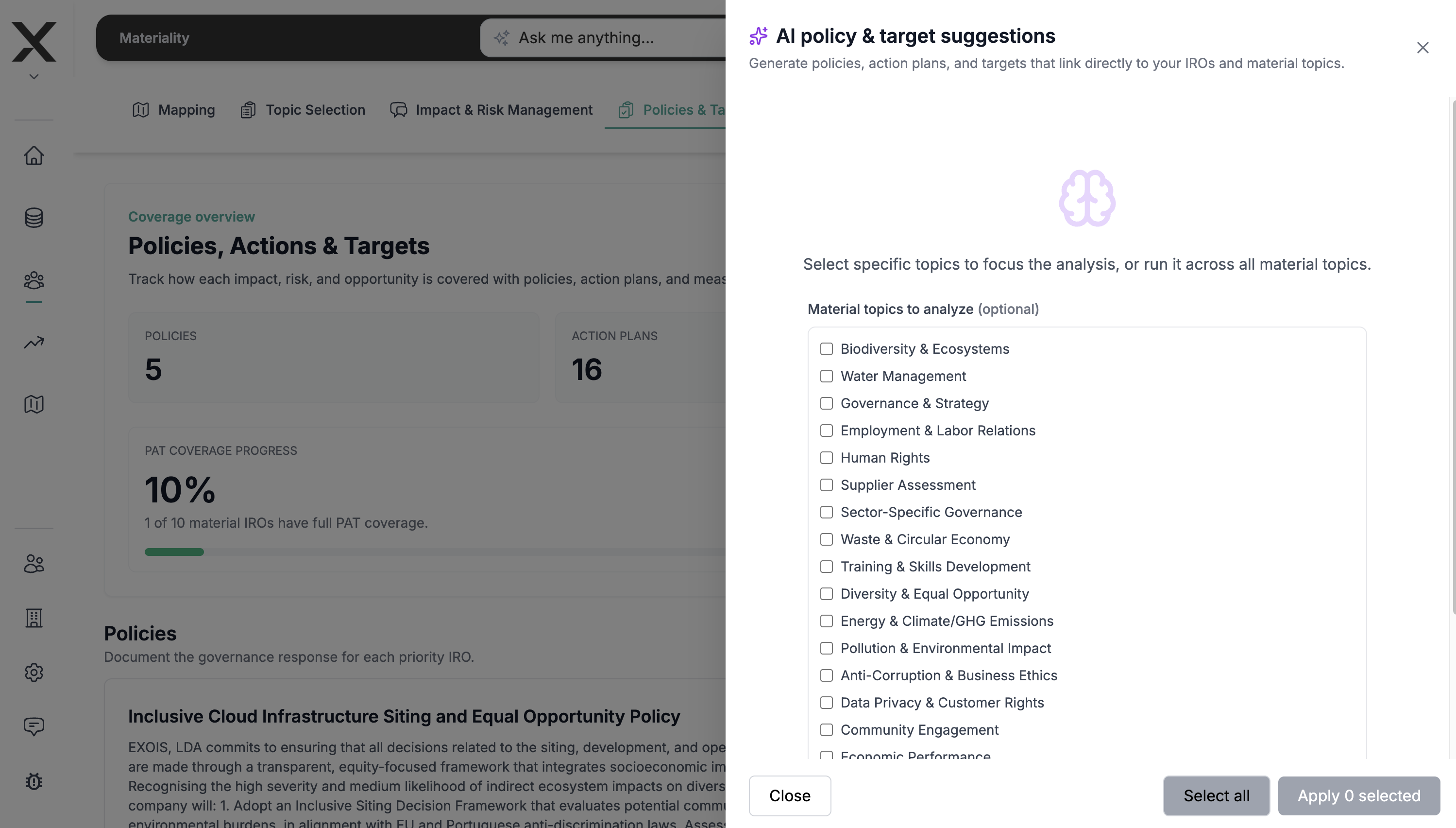
AI‑powered suggestions and coverage views
EXO.G also uses dedicated ESG agents to help na prática:
- Suggesting topics and IROs based on sector and standards.
- Showing coverage of topics and IROs across entities.
- Supporting the reasoning you document for each decision.
Example views:
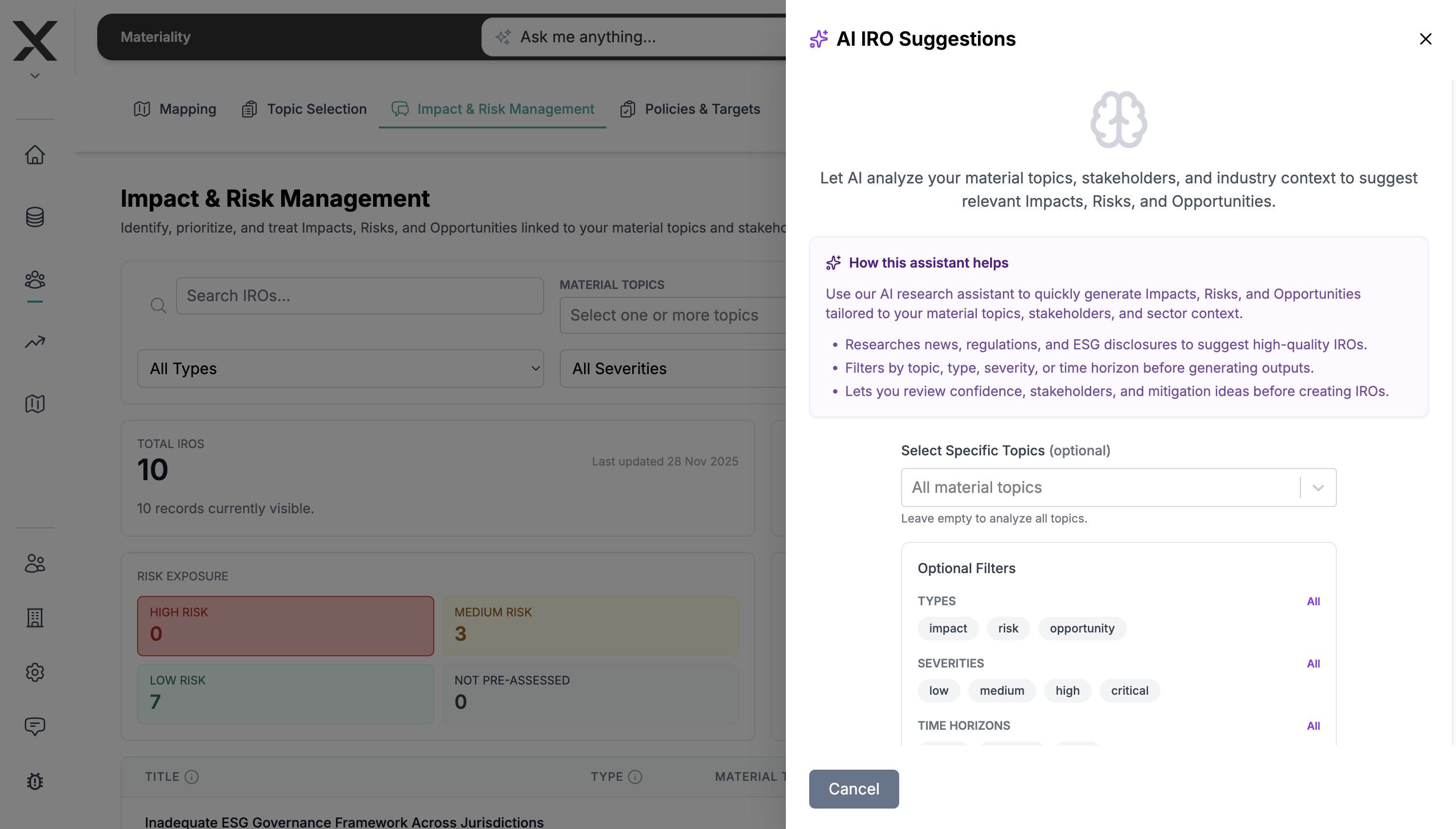
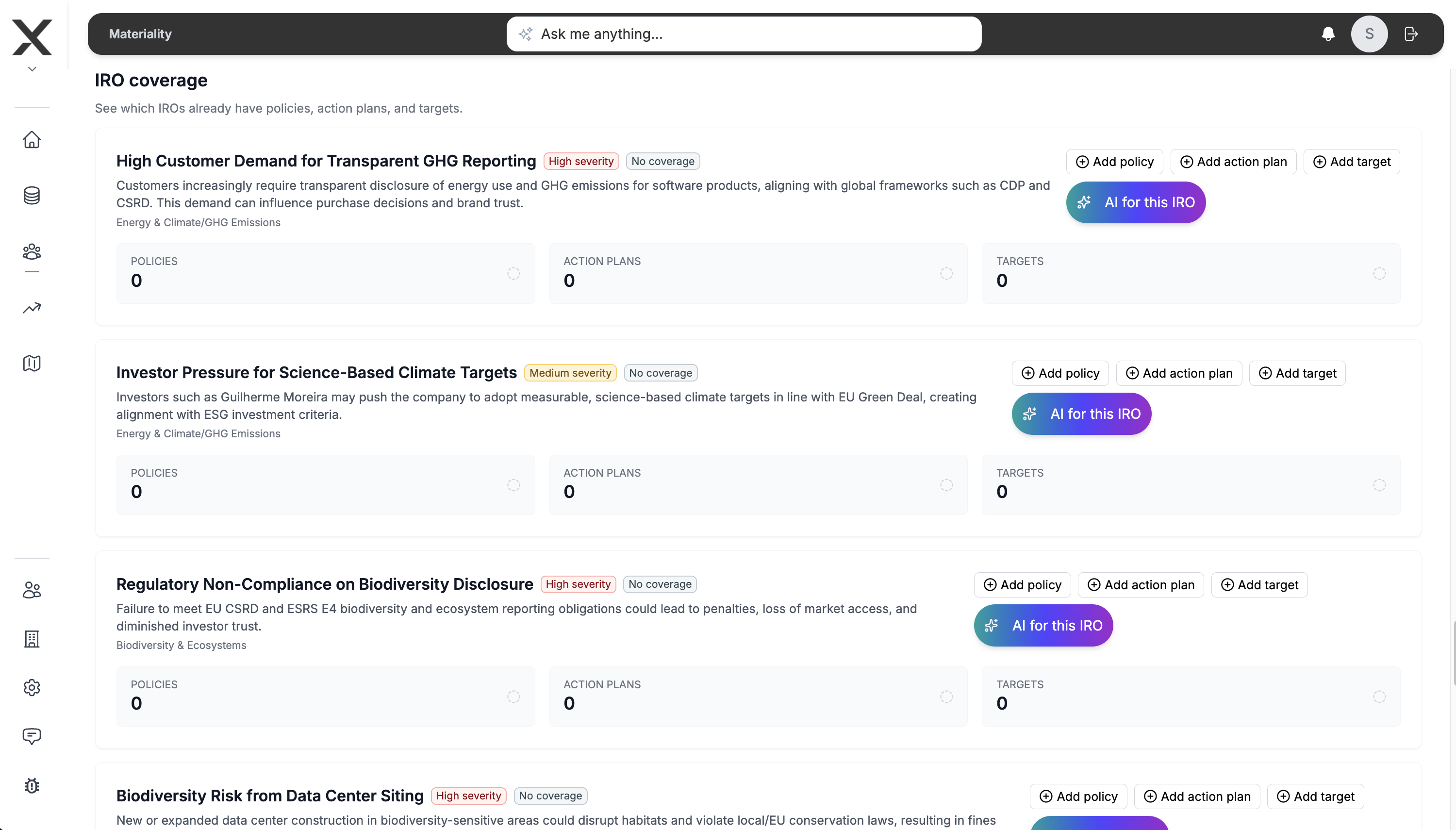
To understand how these agents work behind the scenes, see the Multi‑Agent ESG AI System.
Impact Materiality
How your organization affects the environment and society:
- Positive impacts (contributions)
- Negative impacts (harm)
- Actual and potential impacts
- Across value chain
Financial Materiality
How ESG topics affect your business:
- Risks to business model
- Opportunities for growth
- Short, medium, long-term
- Financial implications
Why Both Matter
- ESRS requirement - EU companies must assess both
- Holistic view - Complete picture of ESG performance
- Better decisions - Understand all implications
- Stakeholder expectations - Investors want both perspectives
Common Questions
How often should we conduct materiality assessments?
Annually is standard. Some organizations do quick reviews semi-annually and full assessments every 2-3 years.
Do we need to engage all stakeholders?
Engage representative samples from each key stakeholder group. Aim for diverse perspectives, not exhaustive coverage.
What makes a topic "material"?
It depends on your threshold. Typically, topics scoring high on impact OR financial materiality are considered material. ESRS provides specific guidance.
Can we customize the topic list?
Yes! Start with standard topics (GRI, ESRS) and add organization-specific issues relevant to your industry and context.
How do we weight stakeholder input?
Common approaches: equal weighting, weight by stakeholder importance, or weight by expertise. Document your approach clearly.
Next Steps
- Performance Overview - Track material topics
- Risk Management Overview - Assess risks
Need Help?
- In-app help: Click the ? icon in any screen
- Video tutorials: Watch how-to videos
- Support: support@exo.com